Every AI agent, accounted for.
Merlon is an agent accountability platform. Find every AI agent in the business, decide whether each action should proceed, stop the whole chain when one turns, and prove it to a regulator.
Built for banks, energy and healthcare in the Gulf. Identity platforms decide whether an agent is allowed to act. Merlon accounts for everything else in an agent's life.
- Agent
- ap-collections-07
- Asked to
- Release AED 480,000 to a payee it had never paid before
- Told by
- An email that came from outside the bank
- Authority
- Borrowed from a person who was never asked
- Verdict
- Stopped
- Elapsed
- 28 seconds from the first signal
An agent moved the money. Nobody can say who told it to.
AI agents now hold their own credentials, spend real money, read confidential data and quietly hire other agents to help. When one goes wrong, no system in your estate can name the human whose authority it was using, stop everything it spawned, or prove to a regulator what it did.
Nobody has the list
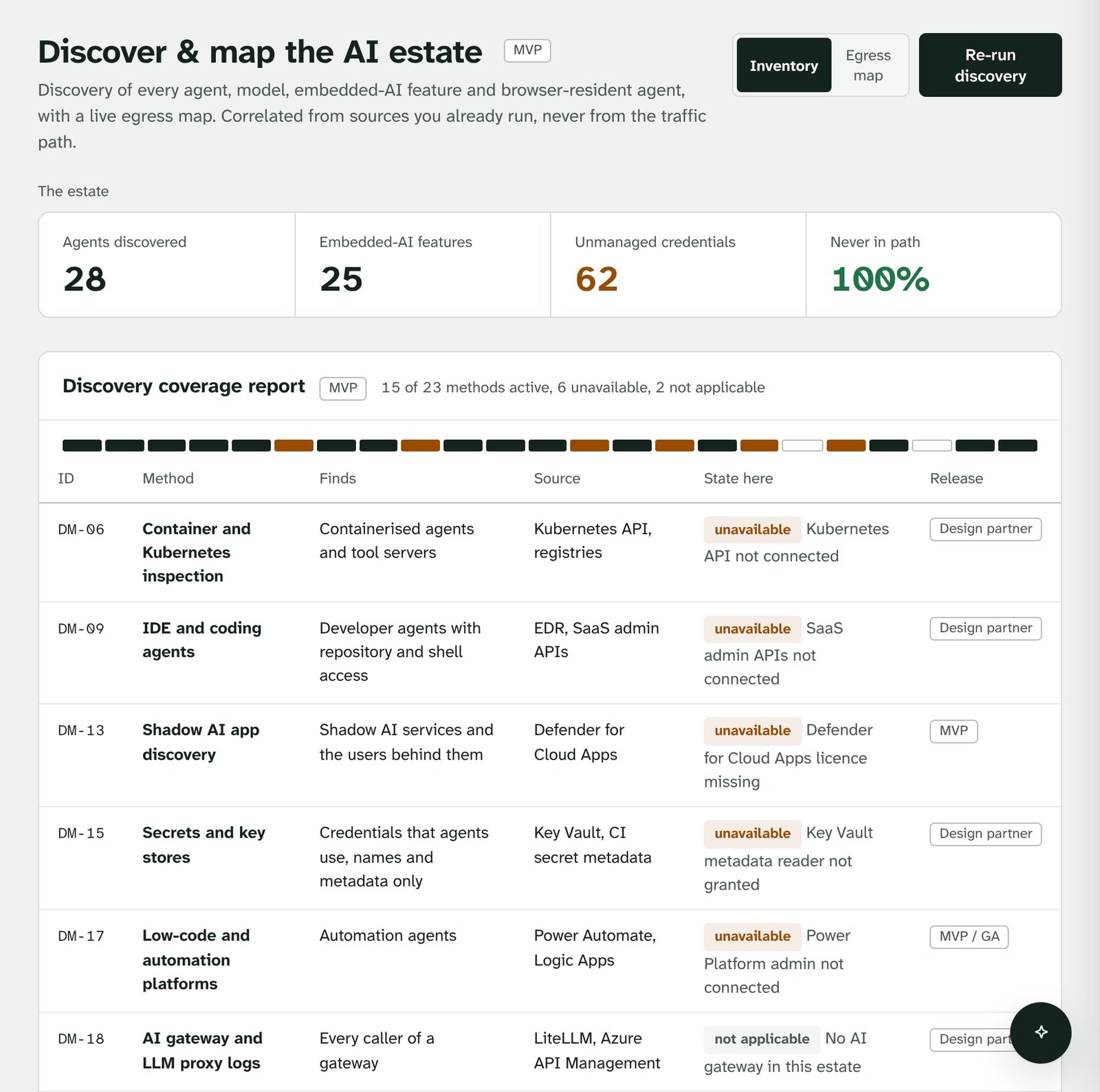
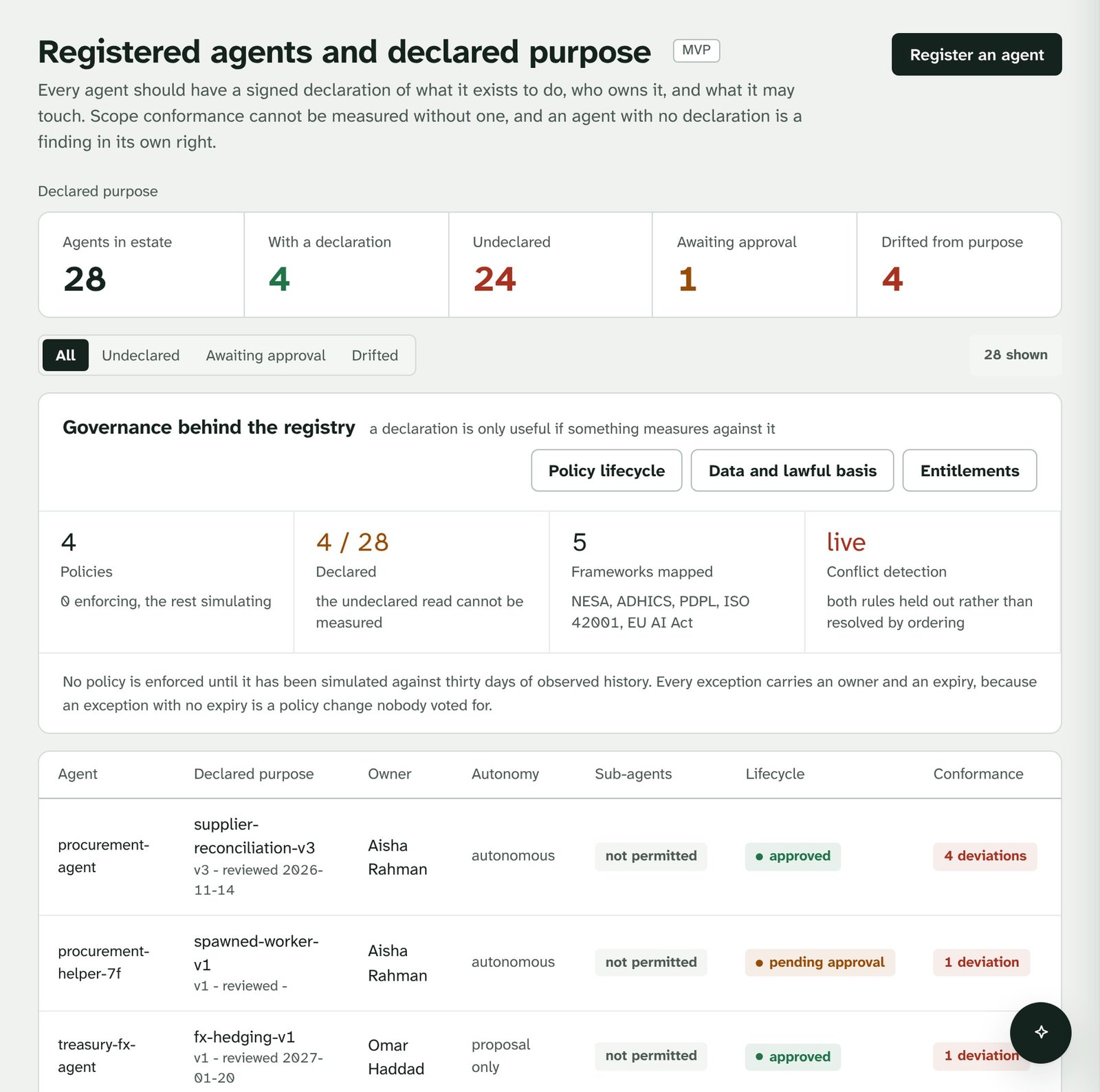
Agents arrive through a tick-box in a SaaS admin panel, a developer's side project, a vendor's quiet upgrade. In the reference estate, twenty-four of twenty-eight agents have no declared purpose at all.
They borrow someone's keys
An agent usually acts with a person's access, so your identity platform sees the person. Revoking a token can take up to ninety minutes, and the token already issued keeps working.
One agent is never one agent
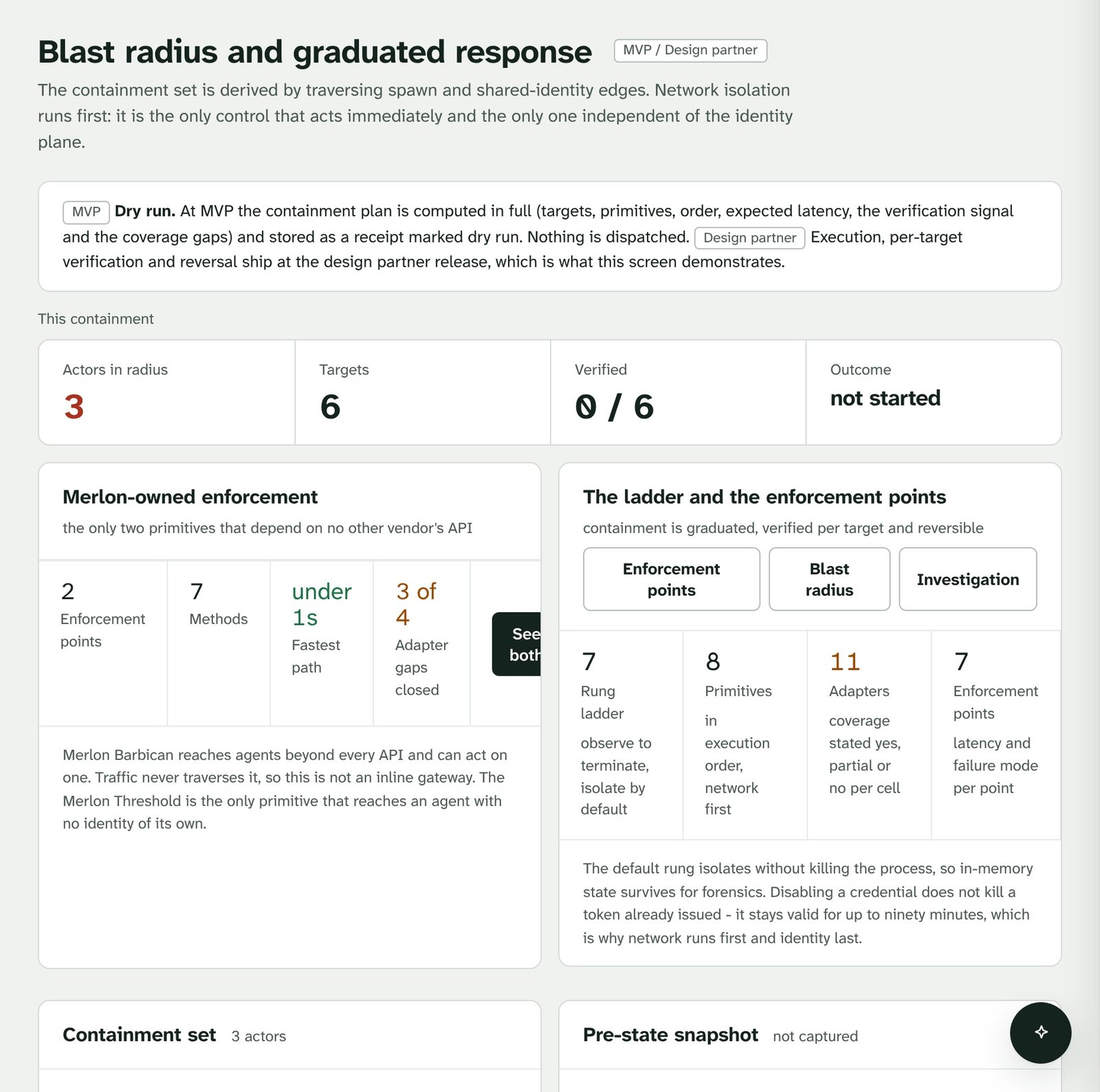
By the time you stop it, it has spawned sub-agents and shared credentials. Stopping the one you found is not the same as closing the blast radius.
One platform. Five modules, three products you can buy on their own.
Discovery builds the graph. The other four modules read it, so nothing is judged without knowing who owns the agent, what it was declared for and what it would reach if it turned.
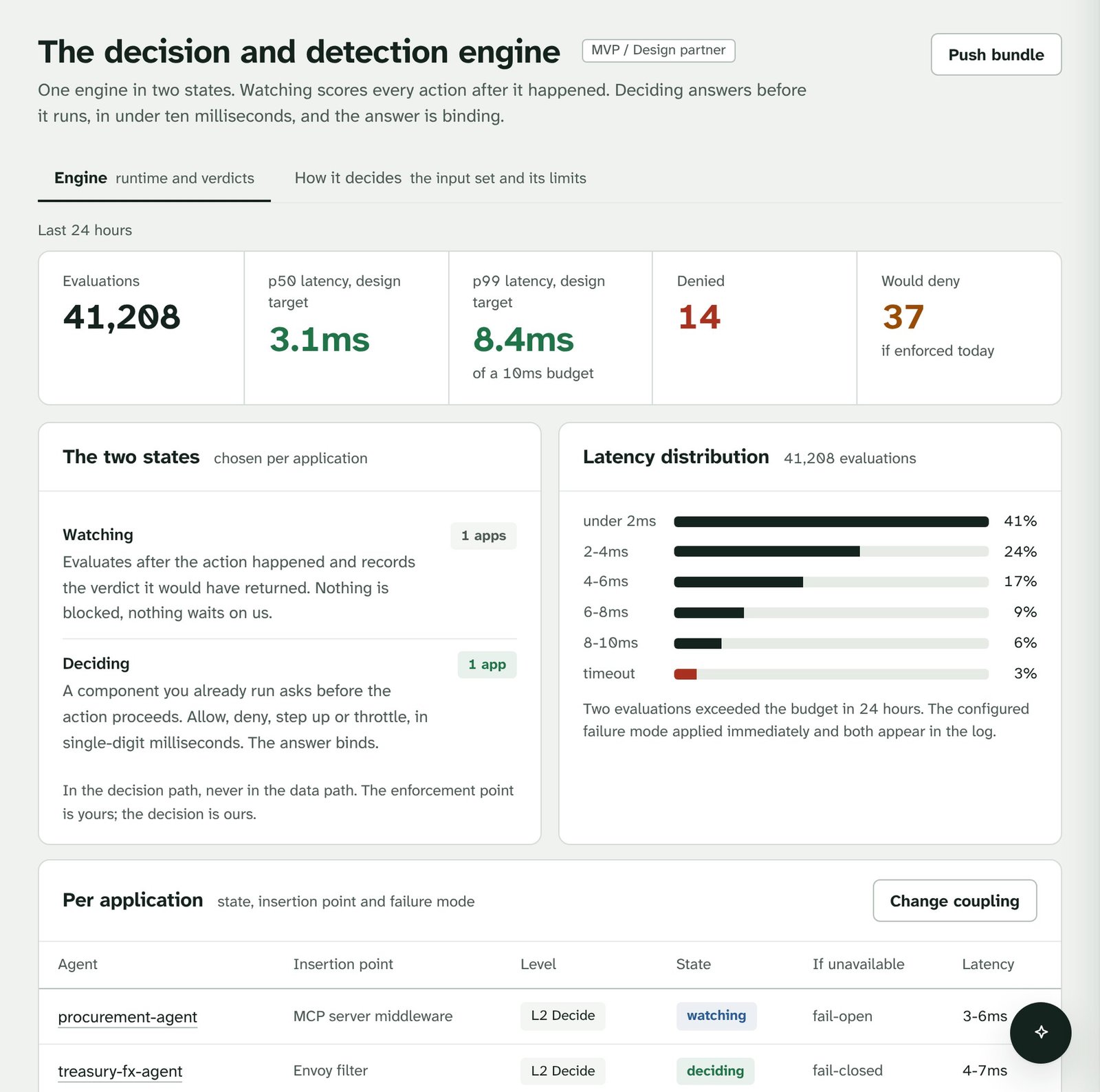
Merlon is in the decision path. It is never in the data path. You choose how deeply it couples per application — observe from logs, emit signed records, decide before the action runs, or broker the credential itself. Read-only is where every deployment starts, not where it has to stay. Merlon Check, the open verifier, is free in every configuration and needs nothing from us to run.
Merlon Keystone, the engine underneath all of it.
Every module reads the same engine. Governance states what an agent is for, Keystone judges against it, Containment acts on the judgement, and Evidence seals the result. Remove it and the arch falls.
A gateway asks whether an action is permitted.
Keystone asks whether it should happen.
Run it in your estate or in ours — your choice, and it can move later. Keystone sits in the decision path and never in the data path, so it does not carry, forward or store what your agents are working on. Every verdict can be opened down to the inputs that produced it and the weight each one carried, because an unexplainable deny is an outage nobody can debug at three in the morning. No single signal decides on its own, however strong it looks.
Three things nothing else in this market does.
The identity vendors answer authorisation well, and we are not trying to replace them. These three are the gaps they leave.
We find agents with no identity at all
An agent working inside a person's own session has no service principal, no token and nothing to govern. To every system in your estate, your identity platform included, it simply is the person. Merlon Threshold separates the two on the same login — which is the one thing a product built around identities structurally cannot do, because there is no identity there to find.
The same account approved the same payment twice. One was a person.
Our proof does not depend on us
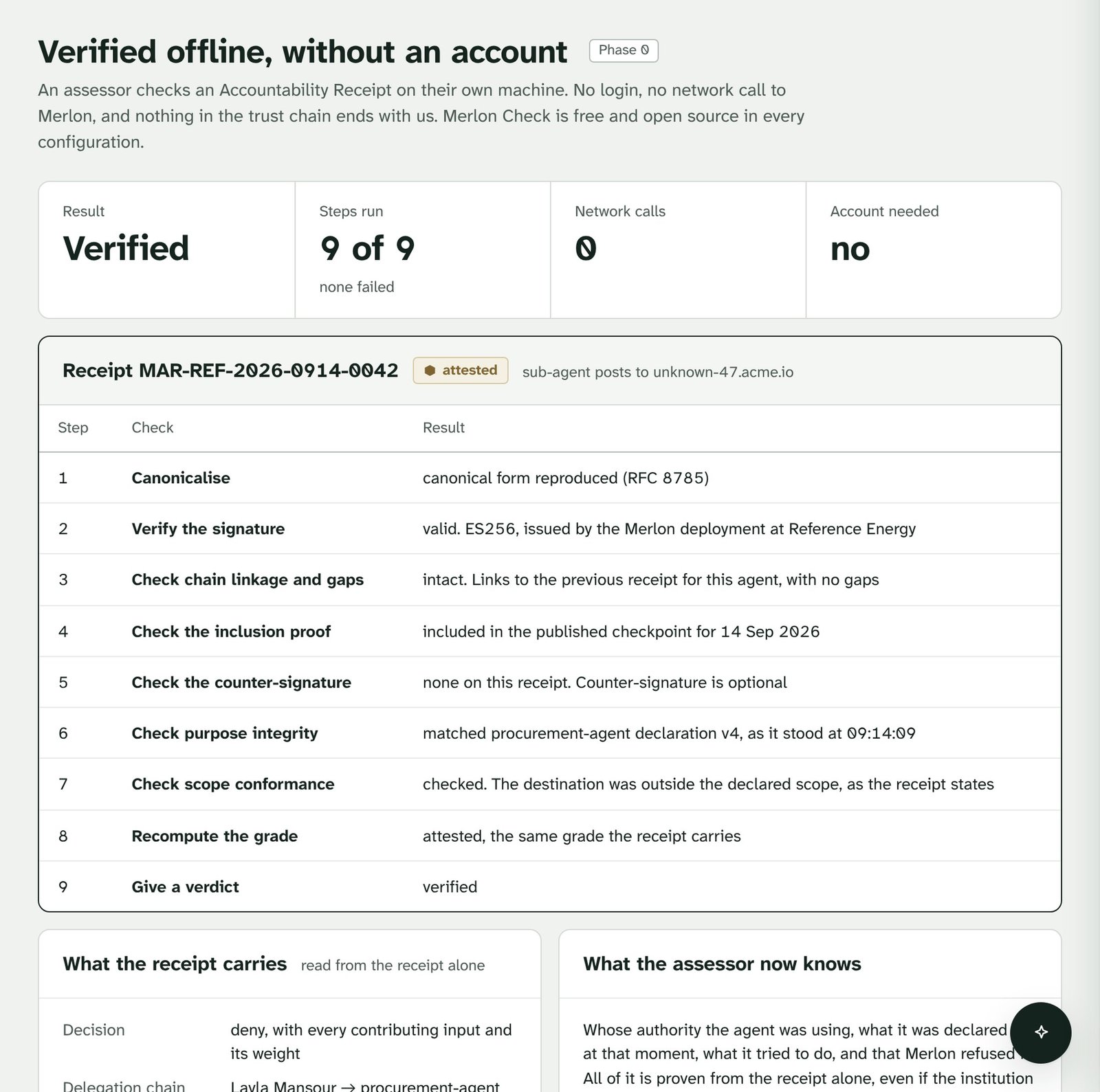
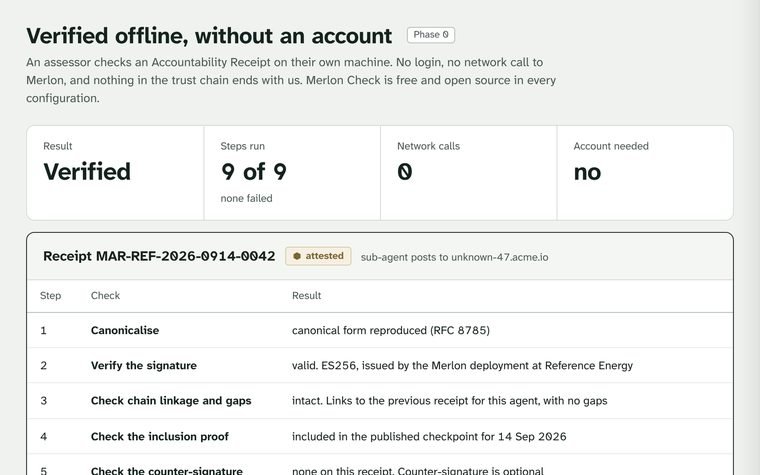
An audit trail is internally consistent and externally worthless. An Accountability Receipt is signed and chained, and Merlon Check — free, open and separate — verifies it offline. Your assessor never needs a login, and never has to take our word for anything.
Nothing in the trust chain terminates at Merlon.
One attack caught anywhere defends everyone
No single institution sees enough agent attacks to build a picture on its own. Merlon Beacon moves the pattern between estates while keeping every record inside the estate it came from. The more institutions on it, the less any one of them is alone.
Sixteen attack types tracked, and the list grows with every sighting.
Twenty-eight seconds.
One sequence, taken from the working build, with the clock running.
A finance agent asks to release a payment to a payee it has never paid before.
Merlon reads the instruction behind the action, not only the action. It traces back to an email from outside the bank.
The verdict goes against the agent. Its declared purpose does not cover new payees, and the authority it is using belongs to someone who was never asked.
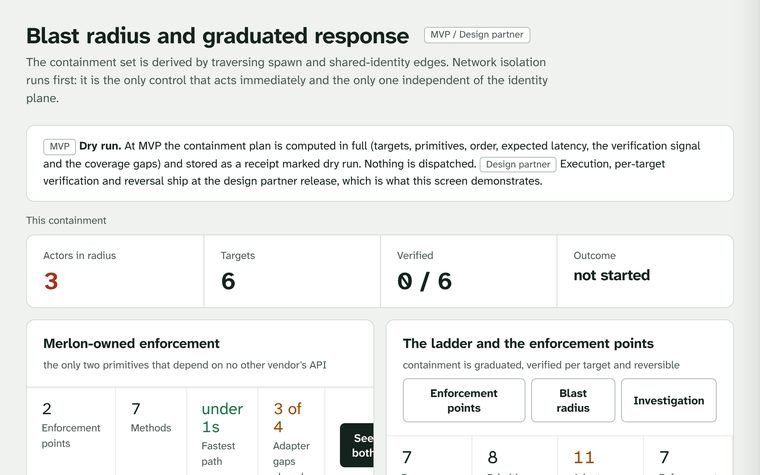
Containment closes the chain — the agent, the two sub-agents it spawned and the credential all three share — and the Accountability Receipt is written and sealed.
Buy the part you need.
Add the rest when the budget does. Discovery is the base and sits in every configuration, because every other module reads the graph it builds. The other four are separable, and so are the three named products.
Said before the contract, not during the audit: Assure without Containment cannot evidence the NESA containment obligation, because there is no containment to record. Every configuration lists what it cannot prove on screen, before you sign. There are no prices on this page because pricing is not set — the modular structure is the commercial argument on its own.
Five screens from the working build.
Not mockups. Click any screen to open it full size.
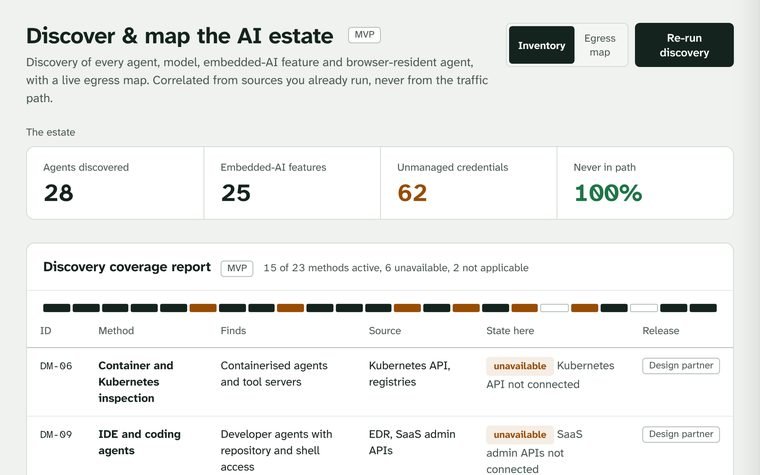 Click to enlarge
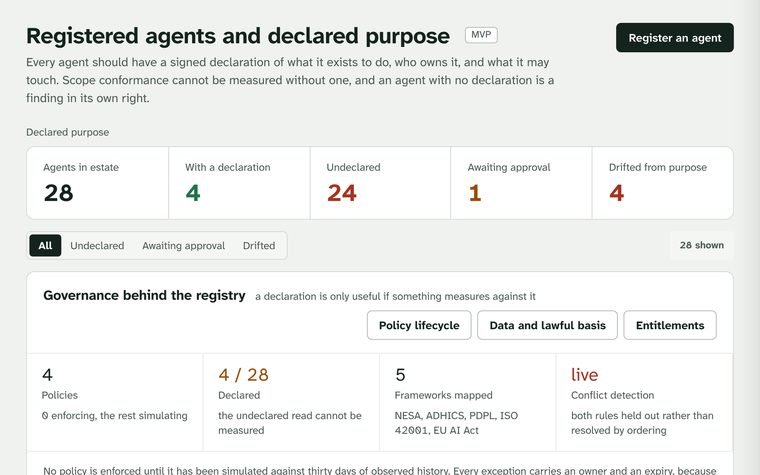 Click to enlarge
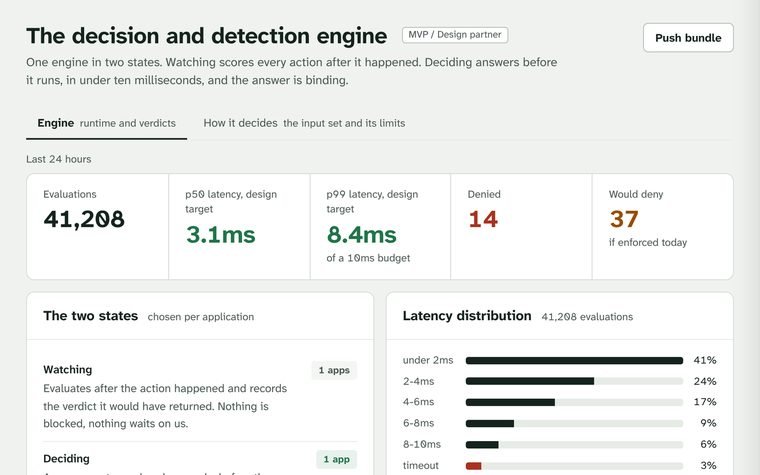 Click to enlarge
 Click to enlarge
 Click to enlarge
The obligations you already answer to.
None of these were written for software that acts on its own. All of them now apply to it. What Merlon produces for each one is a record, not an assertion.
Containment you can show you actually performed, with the time it took and what it closed.
Which agents reached patient data, under whose authority, and whether that authority covered it.
A lawful basis recorded against every agent that processes personal data, before it processes any.
An auditable account of autonomous activity across the estate, including the agents nobody declared.
The declared purpose of every AI system you run, signed and versioned, with drift from it measured.
Human oversight and logging for systems that take consequential action without a person present.
Detections are mapped to OWASP and MITRE ATLAS as well, with the coverage gap published inside the product rather than scored on a website — a number out of ten tells a buyer nothing about whether the ten are the ones that matter to them. Where a configuration cannot evidence an obligation at all, it says so on screen before the contract.
See it against your own estate.
Thirty minutes and one read-only connection. You leave with a list of the agents you are already running, whether or not you go further.
Or write to hello@merlonprotect.com
What you will see
Your own agent list, built live from one read-only connection.
An attack run in front of you, and the verdict that stops it.
The Accountability Receipt it writes, verified offline with Merlon Check.
The gaps. Which agents we cannot reach in your estate, and why.